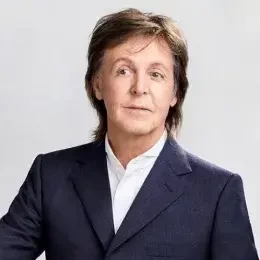
Paul McCartney

Real Name: James Paul McCartney

Date of Birth / Formation: June 18, 1942

Age / Status: 84 years old

Origin: Liverpool, England — rose to fame as a founding member of the Beatles

Primary roles: Singer-songwriter, multi-instrumentalist and producer known for melodic bass playing and versatile tenor vocals

Key collaborators: Longtime collaborators include Linda McCartney and Denny Laine; later high-profile duets with Stevie Wonder and Michael Jackson

Active period: Recording and performing career spans 1957–present

Honours: Two inductions in the Rock and Roll Hall of Fame; knighted in 1997 (Knight Bachelor)

Paul McCartney is an English singer-songwriter and musician who is one of the most successful and influential artists in history. After his legendary career with The Beatles and Wings, he achieved massive success as a solo artist in the 1980s. He released a series of multi-platinum albums and hits, including the number-one singles 'Coming Up', 'Ebony and Ivory' (with Stevie Wonder), and 'Say Say Say' (with Michael Jackson). Known for his melodic songwriting, versatile voice, and exceptional musicianship, McCartney remained a dominant force on the global charts throughout the decade. He has won 18 Grammy Awards and is a two-time inductee into the Rock and Roll Hall of Fame. His enduring popularity and timeless hits have made him a true legend of global music.

Origins and 1980s direction

From Liverpool skiffle to global songwriting success

Raised in Liverpool, McCartney taught himself piano and guitar as a teenager and joined John Lennon’s Quarrymen in 1957; the group evolved into the Beatles, where he shared primary songwriting and lead vocal duties and helped steer the band’s studio experimentation and melodic direction. [1]

Resuming solo work and 1980s collaborations

After leading Wings through the 1970s, McCartney resumed his solo career in 1980. The early 1980s saw him release major solo material and high-profile collaborations that produced international hit singles and maintained his presence on global pop charts. [1]

Paul McCartney — lead vocalist, songwriter and multi-instrumentalist. Notable collaborators: Linda McCartney (keyboard, backing vocals), Denny Laine (Wings), and later duet partners Stevie Wonder and Michael Jackson.

UK No. 1 Records

1

EBONY AND IVORY

Single, 1982, UK [3]

Weeks at No. 1
3
Total chart weeks
10
1

PIPES OF PEACE

Single, 1983, UK [3]

Weeks at No. 1
2
Total chart weeks
12
1

FERRY CROSS THE MERSEY

Single, 1989, UK [3]

Weeks at No. 1
3
Total chart weeks
7
1

RAM

Album, 1971, UK [3]

Weeks at No. 1
2
Total chart weeks
24
1

BAND ON THE RUN

Album, 1973, UK [3]

Weeks at No. 1
7
Total chart weeks
124
1

MCCARTNEY II

Album, 1980, UK [3]

Weeks at No. 1
2
Total chart weeks
18
1

TUG OF WAR

Album, 1982, UK [3]

Weeks at No. 1
2
Total chart weeks
26
1

GIVE MY REGARDS TO BROAD STREET

Album, 1984, UK [3]

Weeks at No. 1
1
Total chart weeks
21
1

FLOWERS IN THE DIRT

Album, 1989, UK [3]

Weeks at No. 1
1
Total chart weeks
20
1

MCCARTNEY III

Album, 2020, UK [3]

Weeks at No. 1
1
Total chart weeks
3
1

THE BOYS OF DUNGEON LANE

Album, 2026, UK [3]

Weeks at No. 1
1
Total chart weeks
4

Chart summary: Paul McCartney achieved 3 UK Number 1 singles and 8 UK Number 1 albums on the main Official UK Singles and Albums Charts. The cards above list each verified chart-topper. [3]

Selected career milestones

  1. Solo debut

    Released McCartney, a largely self-performed solo album that marked his first major work after the Beatles’ break-up. [1]

  2. Ram and Wings formed

    Issued Ram (with Linda) and shortly after formed Wings with Linda McCartney and Denny Laine, beginning a successful post-Beatles band period. [1]

  3. Wings' US success

    Wings achieved significant commercial success, including the US number-one single 'My Love' and the top-selling album Red Rose Speedway. [1]

  4. Resumed solo career

    McCartney formally resumed his solo career in 1980, moving away from the Wings era and focusing on individual releases and collaborations. [1]

  5. High-profile collaborations

    A string of collaborations and solo singles in the early 1980s produced international hits and reinforced McCartney’s commercial and radio presence worldwide. [1]

  6. Solo touring resumes

    Began touring regularly as a solo artist in 1989, a practice that continued into subsequent decades and re-established his live performance profile. [1]

Then & Now

A concise 1980s snapshot paired with a source-linked status update checked on 17 July 2026.

Then · the 1980s

The profile’s own 1980s timeline captures Paul McCartney’s era-defining momentum. These late-decade milestones anchor the period in the original profile.

  • High-profile collaborations
  • Solo touring resumes
Now · 2026 context

No death date listed. Wikidata does not list a death date for Paul McCartney. MusicBrainz lists The Boys of Dungeon Lane (29 May 2026) as the newest catalogued album linked to Paul McCartney. The catalogue note is used as a documented update, rather than a claim about touring or an unverified 2026 project.

Status source check: Wikidata · MusicBrainz. Release dates are catalogue dates; they do not by themselves establish current touring, membership, or a new 2026 project.

Quotes from Interviews

“I wasn't really dead.”
Paul McCartney — Response referenced in a Saturday Night Live sketch about the 'Paul is Dead' hoax. — The Chris Farley Show sketch on Saturday Night Live
“For cruelty to animals, vegetarianism is the great thing to get rid of that.”
Paul McCartney — Comment advocating vegetarianism for animal welfare and environmental reasons. — Animal Times interview, Fall, 1998

Expanded Song List

Annotations for selected 1980s-era Paul McCartney singles and songs, giving release context and concise thematic notes.

Sources

  1. Paul McCartney — Wikipedia — Primary factual chronology and career overview (supplied extract).
  2. Paul McCartney — Wikiquote — Verified short quotations used in the profile.
  3. Official Charts — Paul McCartney — Official UK Singles and Albums Chart history, including peaks, chart dates and weeks at Number 1.
← Back to Charts
Now Playing