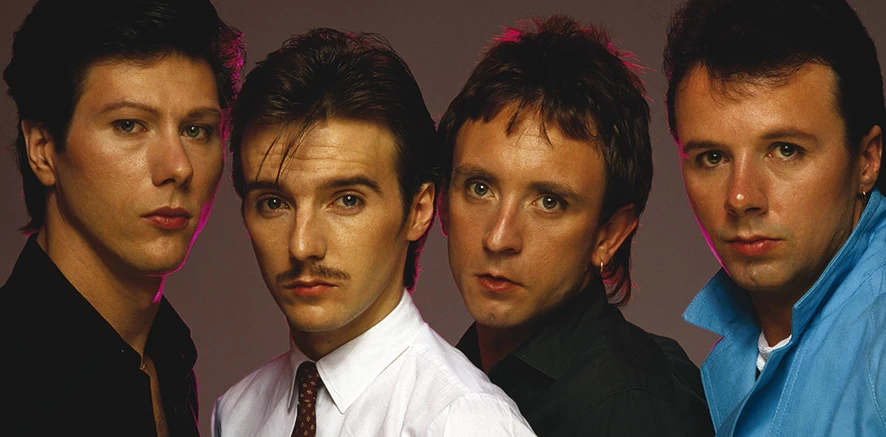
Ultravox

Members: Midge Ure, Billy Currie, Chris Cross, Warren Cann

Date of Formation: 1974, London, England

Age / Status: Active 1974–1988, 2008–2012

Also known as: Formed as Tiger Lily (April 1974); became Ultravox! in 1976 before shortening to Ultravox

Genre: New wave, synth-pop and electronic rock with prominent synthesizers and violin textures

Breakthrough: Vienna (1980); title track became their biggest hit, peaking at UK No. 2 in January 1981

Key collaborators: Producer Conny Plank (Vienna, Rage in Eden) and George Martin (Quartet, 1982)

Reunion highlight: Classic lineup toured in 2009–2010 and released Brill!ant (2012), which reached UK Albums No. 21

Ultravox are a British new wave and synth-pop band who became one of the most influential acts of the early 1980s. After a line-up change that brought in Scottish vocalist Midge Ure, the band released 'Vienna' in 1980, a sweeping, cinematic single that reached number two in the UK charts and became one of the defining songs of the era. Their subsequent albums 'Rage in Eden', 'Quartet', and 'Lament' cemented their reputation for sophisticated electronic rock with orchestral ambitions. The band's blend of synthesisers, violin, and Ure's emotive vocals created a distinctive sound that influenced countless artists. Ultravox also contributed to the wider cultural moment through Midge Ure's co-writing of 'Do They Know It's Christmas?' for Band Aid in 1984.

Formation and breakthrough

From art-school origins to Ultravox!

Ultravox began in London in April 1974 as Tiger Lily, an art-school-rooted group led by vocalist Dennis Leigh (later John Foxx). Early line-ups solidified with Chris Cross, Billy Currie and Warren Cann, evolving through several names before settling on Ultravox! in 1976. Influenced by Roxy Music, Bowie and Kraftwerk, they issued two Island albums, then pushed synths forward on Systems of Romance (1978). After Island dropped them and Foxx departed in 1979, the remaining trio briefly splintered before reconvening around a new direction. [1]

Midge Ure era and 1980s ascent

Brought together via the Visage project, Billy Currie invited Midge Ure to front Ultravox in 1979. Signing to Chrysalis, they recorded Vienna (1980) with Conny Plank, yielding their signature hit. Rage in Eden (1981) deepened the sound, while Quartet (1982), produced by George Martin, delivered four UK Top 20 singles. Monument documented their arena-scale tour. Lament (1984) sustained momentum with major hits, followed by the multi-platinum Collection compilation. After Live Aid (1985), internal changes preceded U-Vox (1986) and a 1987 split. [1]

Midge Ure (vocals, guitar, keyboards), Billy Currie (keyboards, violin), Chris Cross (bass, synths), Warren Cann (drums). Early years frontman: John Foxx (1974–1979).

UK No. 1 Records

Chart summary: The Official Charts history for Ultravox shows no Number 1 release on the main UK Singles or Albums Chart.

1980s milestones

  1. Midge Ure joins and reshapes Ultravox

    Following John Foxx’s departure, Midge Ure takes over vocals, guitar and keyboards after collaborating with Billy Currie in Visage, revitalising Ultravox for a new synth-driven phase. [1]

  2. Vienna album initiates commercial surge

    Ultravox release Vienna on Chrysalis; first single Sleepwalk reaches UK No. 29 and the album initially peaks at No. 14, signalling a rising mainstream profile. [1]

  3. Vienna single becomes their signature hit

    The title track Vienna peaks at UK No. 2; the album rebounds to No. 3. A fourth single, All Stood Still, later reaches UK No. 8. [1]

  4. Quartet with George Martin delivers four hits

    Produced by George Martin, Quartet peaks at UK No. 6 and spawns four UK Top 20 singles; it also becomes their best-charting US album (No. 61). [1]

  5. Lament and greatest-hits boom

    Lament sustains Top 10 album status; Dancing with Tears in My Eyes hits UK No. 3. The Collection compilation reaches UK No. 2 and goes triple Platinum, with new single Love’s Great Adventure peaking at No. 12. [1]

  6. Live Aid appearance

    Ultravox perform four hits at Live Aid, reflecting their stature in the era’s mainstream pop landscape alongside Midge Ure’s Band Aid involvement. [1]

  7. Line-up change, U-Vox and split

    Warren Cann is dismissed before recording U-Vox (released October 1986). Singles underperform relative to earlier peaks; Ultravox decide to disband in 1987. [1]

Then & Now

A concise 1980s snapshot paired with a source-linked status update checked on 17 July 2026.

Then · the 1980s

The profile’s own 1980s timeline captures Ultravox’s era-defining momentum. These late-decade milestones anchor the period in the original profile.

  • Live Aid appearance
  • Line-up change, U-Vox and split
Now · 2026 context

Band/act record. The linked Wikidata record does not list Ultravox as dissolved. MusicBrainz lists The Re‐Mixes (18 April 2026) as the newest catalogued album linked to Ultravox. This conservatively documents catalogue activity without asserting current touring, membership, or a specific 2026 project.

Status source check: Wikidata · MusicBrainz. Release dates are catalogue dates; they do not by themselves establish current touring, membership, or a new 2026 project.

Quotes from Interviews

No short interview quotation was included because an exact, attributable public transcript could not be verified for this profile.

Expanded Song List

Key tracks from Ultravox’s classic era showcase their cinematic synth-pop, combining stately melodies with electronic drama and rhythmic precision.

Sources

  1. Ultravox – Wikipedia — Primary chronology, releases, and UK/US chart peaks cited in the article extract.
  2. Official Charts — Ultravox — Official UK Singles and Albums Chart history, including peaks, chart dates and weeks at Number 1.
  3. Billboard – Ultravox (search) — US chart reference for contextual verification of American chart presence.
← Back to Charts
Now Playing