The 8-bit Computer that Defined a Generation — 250 Classic Games
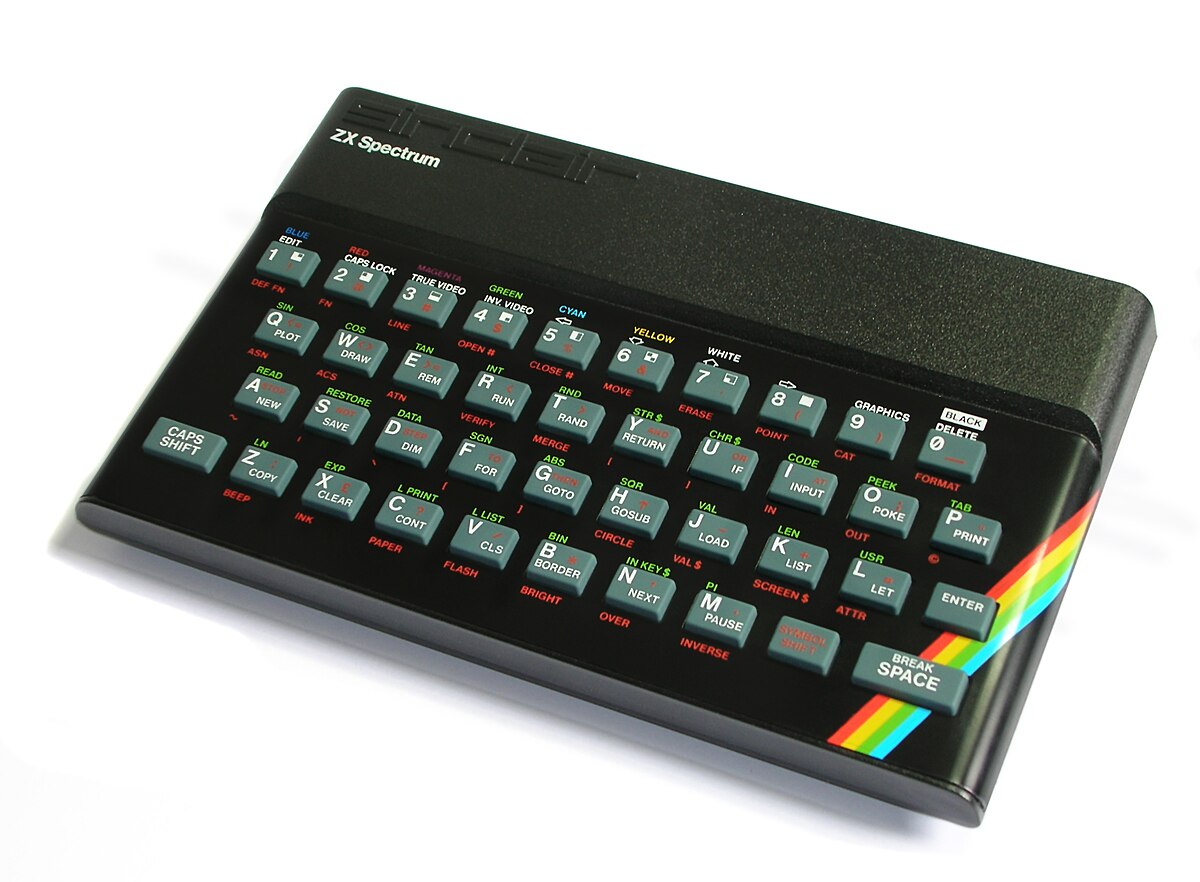
Sinclair ZX Spectrum 48K (1982)
Released on 23 April 1982, the ZX Spectrum was the third home computer from Sinclair Research Ltd. Following the commercial success of the ZX80 and ZX81, the "Spectrum" was named to highlight its most celebrated new feature: colour graphics.
Manufactured by Timex Corporation in Dundee, Scotland, the machine was engineered to be the most affordable colour home computer on the market. It retailed at just £125 for the 16KB model and £175 for the 48KB version — roughly half the price of comparable machines. Its iconic design, featuring a matte-black case with a distinctive rainbow stripe and tactile "dead flesh" rubber keys, was the work of industrial designer Rick Dickinson.
The Spectrum became a genuine cultural phenomenon in the United Kingdom. It sold over 5 million units during its commercial lifespan and catalysed an entirely new software industry. Hundreds of small bedroom developers — many of them teenagers — wrote and sold games through mail-order adverts in magazines like Your Sinclair, Crash, and Sinclair User, effectively birthing the modern British games industry.
The machine's influence extended far beyond gaming. It introduced an entire generation to programming via Sinclair BASIC, and alumni of the Spectrum era went on to found or lead companies including Rare, Codemasters, and Rockstar North.
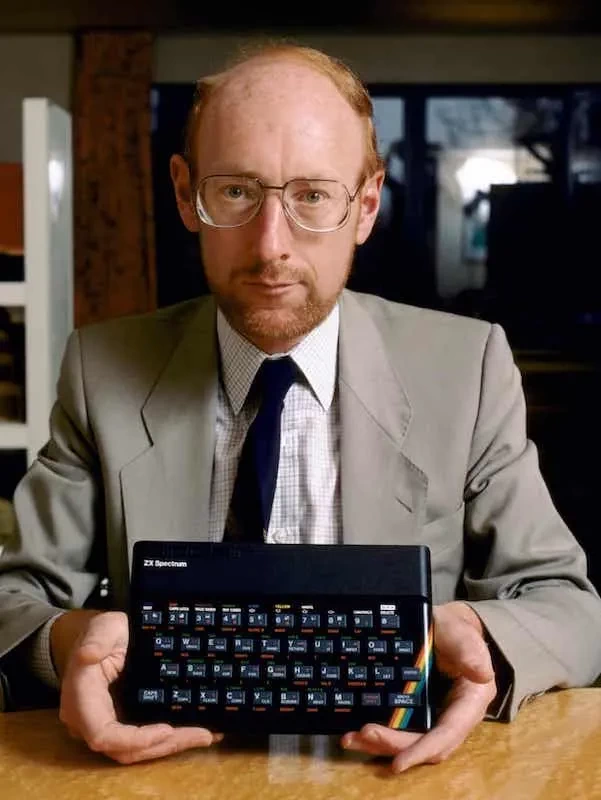
Sir Clive Marles Sinclair (30 July 1940 – 16 September 2021) was an English entrepreneur, inventor, and electronics pioneer whose work transformed the British technology landscape across five decades.
Born in Richmond, Surrey, Sinclair displayed a precocious aptitude for electronics from childhood. He left school at 17 and began his career as a technical journalist before founding Sinclair Radionics in 1961 at the age of just 21. His early products — miniaturised radios, amplifiers, and hi-fi equipment — established his reputation for making sophisticated technology accessible at low cost.
In 1972 he achieved international recognition by producing the world's first slimline electronic pocket calculator, the Sinclair Executive, which sold for £79 and fit in a shirt pocket at a time when calculators were the size of typewriters. He followed this with the world's first single-chip calculator and the first digital watch to retail under £20.
His entry into home computing began with the MK14 kit computer (1978) and accelerated dramatically with the ZX80 (1980), ZX81 (1981), and finally the ZX Spectrum (1982). The Spectrum's combination of colour, sound, and affordability made it the best-selling British computer of all time and earned Sinclair a knighthood in 1983 for services to British industry.
Beyond computing, Sinclair pursued a lifelong interest in personal transport. The Sinclair C5 (1985), an electrically-assisted recumbent tricycle, was a commercial failure but a visionary concept that anticipated the micro-mobility revolution by three decades. He also worked on flat-screen television technology and foldable bicycles.
Sir Clive Sinclair died on 16 September 2021, aged 81. He is remembered as one of the most original and influential figures in the history of British technology — a man who democratised computing and sparked the careers of an entire generation of programmers and game developers.
Sir Clive Sinclair (1940–2021)
— Sir Clive Sinclair, on his design philosophy
Sinclair's guiding principle was radical cost reduction without sacrificing capability. Where competitors priced home computers at £500 or more, Sinclair consistently delivered comparable or superior machines at a fraction of the cost — often by using unconventional components, clever circuit design, and a willingness to accept modest performance trade-offs in exchange for mass accessibility.
This philosophy made him both celebrated and controversial. Critics pointed to the ZX Spectrum's attribute-based colour system (which caused "colour clash") and its rubber keyboard as compromises too far. Admirers argued that without these trade-offs, millions of British children would never have had access to a home computer at all.
| Component | Specification |
|---|---|
| CPU | Zilog Z80A @ 3.5 MHz |
| RAM | 48 KB (16 KB model also available) |
| ROM | 16 KB — Sinclair BASIC interpreter |
| Display | 256 × 192 pixels (TV output via RF modulator) |
| Colours | 8 base colours × 2 brightness levels = 15 colours + black |
| Attribute cells | 32 × 24 character cells (8×8 px each); 2 colours per cell |
| Audio | Internal beeper — 1 channel, 10 octaves |
| Storage | Audio cassette interface (~1,500 baud) |
| Expansion | Edge connector (28-way) for peripherals |
| Keyboard | 40-key rubber membrane (QWERTY) |
| Dimensions | 233 × 144 × 30 mm |
| Weight | 550 g |
| Launch price | £125 (16K) / £175 (48K) — April 1982 |
| Component | Specification |
|---|---|
| RAM | 128 KB (8 × 16 KB banks, paged) |
| Audio | AY-3-8912 sound chip — 3 channels + noise |
| MIDI | RS-232 serial port |
| Keypad | Numeric keypad (right side) |
April 1982 · £125
Z80A · 16 KB RAM · rubber keys · RF output
April 1982 · £175
Z80A · 48 KB RAM · rubber keys · RF output
October 1984 · £179
Improved plastic keyboard; same internals as 48K
1985 (Spain) / 1986 (UK) · £179
128 KB RAM · AY sound · RS-232 · numeric keypad
1986 · £149 (Amstrad)
128 KB · built-in tape deck · two joystick ports
1987 · £249 (Amstrad)
128 KB · built-in 3" floppy disk drive · CP/M capable
The ZX Spectrum's software library is estimated at over 24,000 titles, making it one of the largest catalogues of any 8-bit platform. The low barrier to entry — a BASIC interpreter in ROM, cheap cassette distribution, and an enormous user base — encouraged a wave of independent development unmatched by any contemporary platform.
Key publishers of the era included Ultimate Play The Game (later Rare), Ocean Software, Hewson Consultants, Melbourne House, Codemasters, and Elite Systems. The machine also spawned influential magazines — Your Sinclair, Crash, and Sinclair User — that collectively defined British gaming culture throughout the 1980s.
| # | Title | Publisher | Year | Genre | Watch |
|---|
Sources: Your Sinclair Top 100 (Stuart Campbell, 1991–92), Your Sinclair Readers Top 100 (1993), World of Spectrum visitor rankings, Retro Sanctuary Top 100, and Retro Dodo editorial rankings. Gameplay videos sourced from YouTube; all rights belong to respective copyright holders.
Play authentic ZX Spectrum games directly in your browser, powered by the Internet Archive's Software Library — over 10,000 titles preserved and playable via the JSMESS emulator. Click any featured game below to launch it instantly, or open the full Archive library to browse the entire collection.
Games are emulated in-browser via the Internet Archive ZX Spectrum Software Library. Use keyboard controls: Enter to start, arrow keys to move, Z/X for fire on most titles. Some games may require a specific key mapping — check the Archive page for details.
LOADING TAPE…